

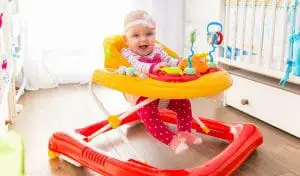
 For years, parents have used walkers as a way to help their little ones learn to walk earlier. New studies have found that walkers do not, in fact, help babies learn to walk earlier.
Nevertheless, parents still use walkers today but more as a way to provide entertainment and mobility to their little ones.
Here are ten of the most popular walkers available:
Our Top Picks
- There is an area for snacks.
- None of the entertainment features require batteries.
- The walker can be converted from a sitting walker to a standing walker.
- The walker can be folded up for storage.
- There are skid resistant safety pads on the wheels.
- The walker is JPMA certified.
- The walker has a higher back for additional support.
- The walker has safety breaks.
- The entertainment center can be removed for on-the-go fun.
- The entire walker folds up when not in use.
- The back of the seat is higher for additional support.
- There are plenty of activities on the entertainment panel to keep your child entertained.
- The walker can be folded up for storage or floor play.
- The walker can be used for longer as there is no weight limit.
- There is an area for snacks.
- None of the entertainment features require batteries.
- The walker can be converted from a sitting walker to a standing walker.
- The walker can be folded up for storage.
- There are skid resistant safety pads on the wheels.
- The walker is JPMA certified.
- The walker has a higher back for additional support.
- The walker has safety breaks.
- The entertainment center can be removed for on-the-go fun.
- The entire walker folds up when not in use.
- The back of the seat is higher for additional support.
- There are plenty of activities on the entertainment panel to keep your child entertained.
- The walker can be folded up for storage or floor play.
- The walker can be used for longer as there is no weight limit.
*All product links in this article will take you to the latest prices on Amazon.com, scroll down for our in-depth reviews below.
What is a Baby Walker?
A baby walker is a baby seat on wheels which provides room for your little one’s feet to touch the floor. This will give your child the opportunity to push off or walk while in the device. Walkers are one option for freeing up your own hands without having to use the confines of a playpen.
In recent years, walkers have become controversial, according to Livestrong. Canada has already set in place a ban on all walkers due to many injuries that have resulted from their use. The American Academy of Pediatrics has tried pushing for a ban in America as well.
Many of the injuries have resulted from parents using walkers as babysitters. Walkers, like any other equipment used for infants, should be used with proper supervision and safety cautions. When used properly and in moderation, walkers are a fun device that many infants have enjoyed scooting around their room in.
A child uses a walker before they are able to walk and after they have developed the required cognitive abilities to propel themselves. A walker shouldn’t be used before a baby can hold up their own head, as most walkers offer little to no head support.
Walkers should also only be used if your child’s feet can touch the ground. There are many concerns about a walker’s affects on your child’s hips.
Leaving your child’s feet dangling, or promoting your child walking on their toes are both unhealthy for your child’s development. Most walkers can be used between 4 and 16 months old.
Baby Walker Health Concerns
Walkers are not meant to teach your child to walk. According to an article in ABC News, studies have shown walkers to actually hinder your child’s ability to learn to walk. It can also delay other cognitive abilities. This is why walkers should be used in moderation, and not as a substitute for a walking teacher.
Using a walker does not normally keep a child from walking altogether. It just delays that specific development. It is said that the walkers tend to develop the calf muscles before the rest of the body is ready to walk.
They can also, when used improperly, teach a child to walk on their toes or other unnatural ways which affect their regular walking as well.
A walker can also keep a child from learning to walk. Walkers do not allow a child to see their own feet and learn from observation.
They may lean too heavily on the walker itself, and never push themselves to learn to walk otherwise. Other methods should be used to teach your child to walk, and a walker should only be used as a fun way of hands-free entertainment for your little one for short periods of time.
Teaching a Baby to Walk
Teaching your little one to walk takes a lot of patience and practice. Walkers are not meant to replace or quicken this process. The entire walking process begins around 4 months old, according to Parents.
4-7 Months
This is the age that your child will first begin sitting up without assistance. This sitting up stage can last from 4 to 7 months old. During this time, try encouraging play activities that strengthen the muscles used when sitting.
7 Months
Around 7 months old, your child will begin crawling. They may start by just scooting across the floor on his stomach. Eventually, you will want your little one on their hands and knees and moving in synchrony.
If your child is able to move his arms and legs together, he will already have important coordination skills needed when he begins to walk. This crawling stage can last from 7 to 10 months old.
8 Months
Around the 8 month mark, your child will start pulling themselves up. This could mean using a couch, your legs, or any curtains or hanging objects within reach.
He will not be able to stand on his own, and will still continue to crawl. During this stage, be sure to help teach your child how to lower themselves after they climb up in order to prevent them falling back down.
When your child starts pulling themselves up, you can help develop their skills further by holding them and encouraging them to take steps with your assistance.
9 Months
Around 9 months, your child may switch back and forth between crawling and using walls and furniture to hold themselves up to walk.
9-12 Months
Between 9 to 12 months, your child will start standing on his own. This may be just for a few seconds, but allow them to stand as long as they are able before swooping in to save them from a fall. This will encourage your child to gain confidence to stand on his own for longer without always relying on a parent.
Once they are stable, your child will begin trying to take their first steps. This will usually occur before they reach 12 months old. Each child is different, so some may be able to take those first steps before 12 months, and some may still be crawling at 12 months.
Once your child is taking those steps, try to encourage them to walk as often as possible. Hold their hand and walk with them short distances instead of carrying them.
Even when you do carry them, set them down on their feet instead of on their bottoms so that they will walk to their next destination instead of crawl.
Walking is a natural developmental cycle of every child. The only equipment children need to learn to walk is you and themselves. Walkers and other devices that make claims about helping in this process should be considered skeptically.
Nothing has been discovered yet that works better than just encouraging your child to try walking on their own, except if medical intervention is required. So, if you register for that walker, use it as entertainment, not as a walking alternative.
Types of Baby Walkers
There are many different types of baby walkers available. The only feature that all baby walkers have in common is that they have wheels in order to provide mobility when your child is using the walker.
Sitting Walkers
The two main types of baby walkers are sitting walkers and standing walkers. Sitting walkers are the type that most people picture when they think of walkers.
They are what looks like a high chair type of seat suspended over a circular plastic stand with tires. These can be used as early as your child is able to sit on their own.
Standing Walkers
A standing walker is for toddlers who have reached the stage of pulling themselves up. This looks closer to the style of adult walkers.
These devices will have handles or some other sort of grip, and a front device with wheels. The child has to be able to stand and move forward, pushing the walker while leaning on it for support.
Walkers are great for entertainment. This is why most walkers have an entertainment center attached. This can include buttons, lights, toys, and other items that your child can play with while in the walker.
Some walkers also have a food tray. This should be used with caution as a child should not be eating when they are mobile as this can lead to choking.
The tray can be used to place other entertainment items on it as well such as books or stuffed animals for your child to play with.
A great feature for many walkers is a stationary feature. This will allow you to remove the mobility aspect of the walker and turn it into a regular entertainment center.
You then reduce the risk of your child hurting themselves if you are not able to supervise them constantly for a few minutes. This will also allow you to give your child snacks without worrying about them moving and choking.
If a walker is JPMA certified, it will have two additional safety features. The first will be a wider base to prevent the walker from leaving a room. The second feature that this seal indicates would be the ability of the walker to be stopped from going downstairs through braking pads.
Baby Walker Alternatives
While baby walkers have some benefits, parents may prefer to find a safer alternative for entertaining their child. There are two other devices with a similar entertainment value as the walker, and these are the exersaucer and jumper.
Exercauser
The exersaucer is a stationary walker. It looks very similar to the walker in the way that the seat is placed in the center for your child. It also has an entertainment center of buttons, lights, and toys attached to the railing of the exersaucer.
Some may even allow for twisting and jumping while seated. The only part of the exersaucer that is different is the fact that there are no wheels which will keep your child safer.
Just keep in mind that remaining in this seated position for a long period of time can affect your child’s development. Also, be sure to use the same guidelines as the walker when it comes to age.
If your child is too young and their feet dangle, or they are too big and their feet are crammed, then the exersaucer can have serious negative effects on your child’s health.
Jumper
The second option is the jumper. There are two main types of jumpers available. The first kind is the jumper that attaches in a doorway.
These can pose safety hazards as your child could jump too high or too enthusiastically which can swing the jumper into a wall.
The stationary jumpers are slightly safer, though they pose their own risks of stability. Neither should be used without parental supervision. The jumper again should only be used for short periods of time.
All three devices, the walker, jumper, and exersaucer, are for your child’s entertainment, and should not be used as a babysitter.
If you need time to yourself to clean or cook, try using a playpen as a safer environment for your child, which requires less hands on supervision than the other devices.
Another option is to just allow your child to roam around the floor. This is very healthy for your child’s development. It requires just as much supervision as the walker, with greater developmental benefits.
This is not to say walkers should not be used, but there is a time and place for them. Nothing works as well for your child’s development as allowing them a little freedom to explore.
Baby Walker Safety
There are many safety issues associated with walkers which are what have led many pediatricians and others to caution against their use. Walkers can still be used as long as you are aware of the risks and take the appropriate safety steps to avoid possible dangers.
According to Healthy Children, a walker can be moved as fast as 3 feet in a second. This is why even with proper supervision, walker accidents still occur. If a walker is going to be used, additional steps must be taken beyond just watching the child.
One major danger of walkers are children who fall down stairs. Children should not be allowed to roam freely about the house in a walker. Child safety gates should be used on all stairs.
To be even safer, try to limit the walker use to one room by closing all doors. Many of the modern walkers are made wider so that they cannot fit out of the average door.
But, this should not take the place of implementing your own safety steps. Another safety feature is a wheel brake or something similar which allows the walker to be stopped before falling down stairs. If a walker has a stamp from JPMA, it will be both wider than a doorway and have the wheel brakes.
Walkers have been known to result in a child getting burned. There are many devices and items in the house that heat to dangerous temperatures.
Anything from hot coffee to stove tops are burn hazards to your little one. When your child is in the walker, they are able to reach higher than before. This can open up access to heaters, stovetops, or table clothes that can be pulled along with any hot beverages on top of the table.
Before setting your child in the walker, remove all items and devices that could potentially hurt your baby, no matter how high they may be. It is best to choose rooms that are free from all potential hazards, such as a nursery.
There have been cases of children drowning in a walker. This is especially true if they are outside where there is a pool or other form of water.
If a child falls in water, no matter how shallow, they can drown. This has even occurred inside by children falling in bathtubs. Be sure there is no access to water when your child is in their walker.
Walkers give your child access to harmful chemicals and food. Again, this is related to the fact that your child is higher up than they normally would be. This means that many of your baby proofing will no longer apply to them.
They can reach counters and cupboards that you would not have baby proofed as they are unreachable to a crawling baby. No matter how young your child is, always keep harmful chemicals, or choking hazards locked away. This should especially be true when your child is in a walker.
The best place for a child to use a walker would be their own nursery where there are only safe items at all levels. There is also no safety hazards in regards to temperature or sharp items that your child could reach. Be sure all doors are closed and locked so they avoid pinching their fingers.
As long as you are cautious about your surroundings before putting your child in their walker, walkers can still be safe and fun devices for your little one. They will love exploring around the room with the feeling of freedom that playpens do not offer.
Ten Best Baby Walkers Reviewed


The entire walker has passed the ASTM F977 Safety Standard. The walker fits children up to 25 pounds and 32 inches in height. When you are not using the walker, it can be folded up for storage.
This walker can be adjusted to your child’s height as they grow. There are three different height positions that the seat can be set to.
In addition, the walker can also be switched between the walker setting, and a stationary setting where you do not need to worry about your child wandering off.
The walker has two main features. The first is the walker setting. In the walker setting, four 360 degree swivel wheels easily move across hardwood and tile floors.
The base is wide enough to prevent your child from passing through average doorways, for their personal safety. The second feature is the rocking feature. In this mode, the walker is stationary and can be rocked back and forth while your child is slightly tilted back.
The front of the walker holds a tray with a removable entertainment center. The entertainment center holds just a few small buttons, beads, and a steering wheel.
When the entertainment center is taken out of the tray, there is a clear area for snacks, as well as a cup holder for a bottle. The seat padding can also be removed when it comes time to wash the walker.
Cons: Dream on Me is a name known in the baby furniture niche. They have been known for their strict safety standards and quality products. Their walker is not their most popular product that they have produced. That being said, it still holds a certain level of quality, and passes the safety requirements. The main area of quality that is lacking is in the entertainment center portion of the device.
There are three height adjustments so that the walker can grow with your baby. Your child can use the walker up until 26 pounds. When you are finished, you just need to fold the entire walker up for storage. The walker can either be used as a mobile walker, or a stationary entertainment center. When it is a walker, there are bumpers that can be placed around the base in order to protect your walls from getting scratched up. There are also brake pads to stop the walker’s wheels if it goes over a step or other sharp decline. The activity center is based around music. There is a piano, rattle, and lights to help encourage your child to dance. There is also a drawer that opens up to reveal an MP3 connection. Smaller MP3 devices can be placed inside the drawer and play music for your child while they are in the walker. Larger devices like phones may not always fit in the drawer, unless you keep the drawer open. The entertainment center can be taken out of the walker and used on the floor as well. The seat padding can also be removed in order to clean them easier. Cons: Any future music and dance talents will love this little musical walker. From a rattle to a small piano-type device, it has a good variety of musically themed items to keep your child moving. The MP3 plugin is a great addition to mix up the music a little to something both you and your little one will enjoy listening to. Just be sure to remove the batteries between uses or else the entertainment panel will drain the batteries quickly. In this way, the walker will last your little one longer as they develop. The walker can be used for children up to 26 pounds and 32 inches tall. The entertainment center only has three items. Each item was carefully chosen in order to help develop a different sensory area. A bead bar helps to develop your child’s fine motor skills. A textured flower helps stimulate your child’s senses, and a batting ball is for your child’s entertainment. None of the items require batteries. The entire entertainment center can be removed in order to use the full tray area for snacks or small toys. Even when the entertainment center is attached, a small area and a cup holder is still available for snacks. The walker’s seat has multiple adjustment levels as your child grows taller. When your child has outgrown the seat, the seat of the walker can easily be lifted out to provide a standing walker. The base remains the same safe width even as a standing walker. Your child can also still use the entertainment center. When you are not using the walker, it can be folded up for storage. The seat can also be removed to clean. Cons: This is a very simple entertainment center that can be used longer than a regular walker. Even when your child outgrows the seat, they can still use this walker as they continue developing. The simple toys are enough to keep your child entertained without all the bells and whistles that can sometimes shorten a toy’s longevity. Just don’t use this walker with heavier children as it is a cheaper plastic and has not always held up to heavier use. The walker is available in four different colors and bright designs to attract babies of all personalities. When you no longer need the walker, it can be folded up and stored away easily. The entertainment center is a mixture of electronic battery controlled items and non-battery items. The non-battery items include a steering wheel and spinning beads. The battery is used for the musical feature, which can be controlled through a volume control. There are two additional empty hooks for attaching your own items to add on to the entertainment center. The entire entertainment center can be removed for floor play or to open up the tray area for snacks and other items. The walker comes in three different height positions so that it can grow along with your child. The seat has a higher back for additional support for your little one. The wheels have a safety brake that will help prevent the walker from falling down stairs. The entire walker can be used up to 26 pounds. Cons: The Bright Stars Walk-A-Bout Walker is a simple little walker with an affordable price tag. There are only a few little lights and sounds, but overall the walker is very limited when it comes to its entertainment value. The walker is also limited as to its versatility as it has no conversion options. It cannot even convert to a stationary entertainment center. Though, the removable entertainment tray does allow for a slight change between a walker and floor play. All in all, it does work well as a basic walker for a decent price. There are three different ways that this walker can be used. The first is as a basic walker. There are four wheels as well as a handle on the back. Your child can walk while holding the handle to help keep themselves upright. The second option is to lock the wheels. This will keep the walker stationary so that your child can use it as an entertainment table. The third option is to collapse the entire walker so that it converts to an entertainment board. This entertainment board is a great option for your little ones who cannot stand up yet to use the board during floor play. The activity walker is filled with many different lights, buttons, and sounds. The board does require batteries to operate some of the items. Some of the entertainment options on the board are a slider, spinning balls, gears, and musical buttons. The entire walker is jungle themed and makes some fun animal sounds along with some of the items. A giant center light projects a colorful design in front of your child as they are walking with the walker. Cons: While this walker does not offer the option of sitting for younger children, it is a decent second stage walker as your child advances. Before they are walking, the collapsible entertainment board option can be used. The entire walker has quite a bit to offer when it comes to buttons and lights. Most parents tend to use the entertainment center feature only, and never use the walker feature due to the issues with the wheels and maneuverability.
Chicco Dance Walker Activity Center

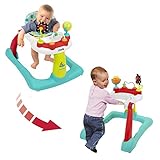
Kolcraft Tiny Steps 2-in-1 Activity Walker

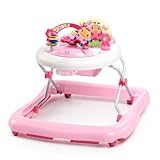
Bright Starts Walk-A-Bout Walker

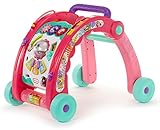
Little Tikes 3-in-1 Activity Walker


